

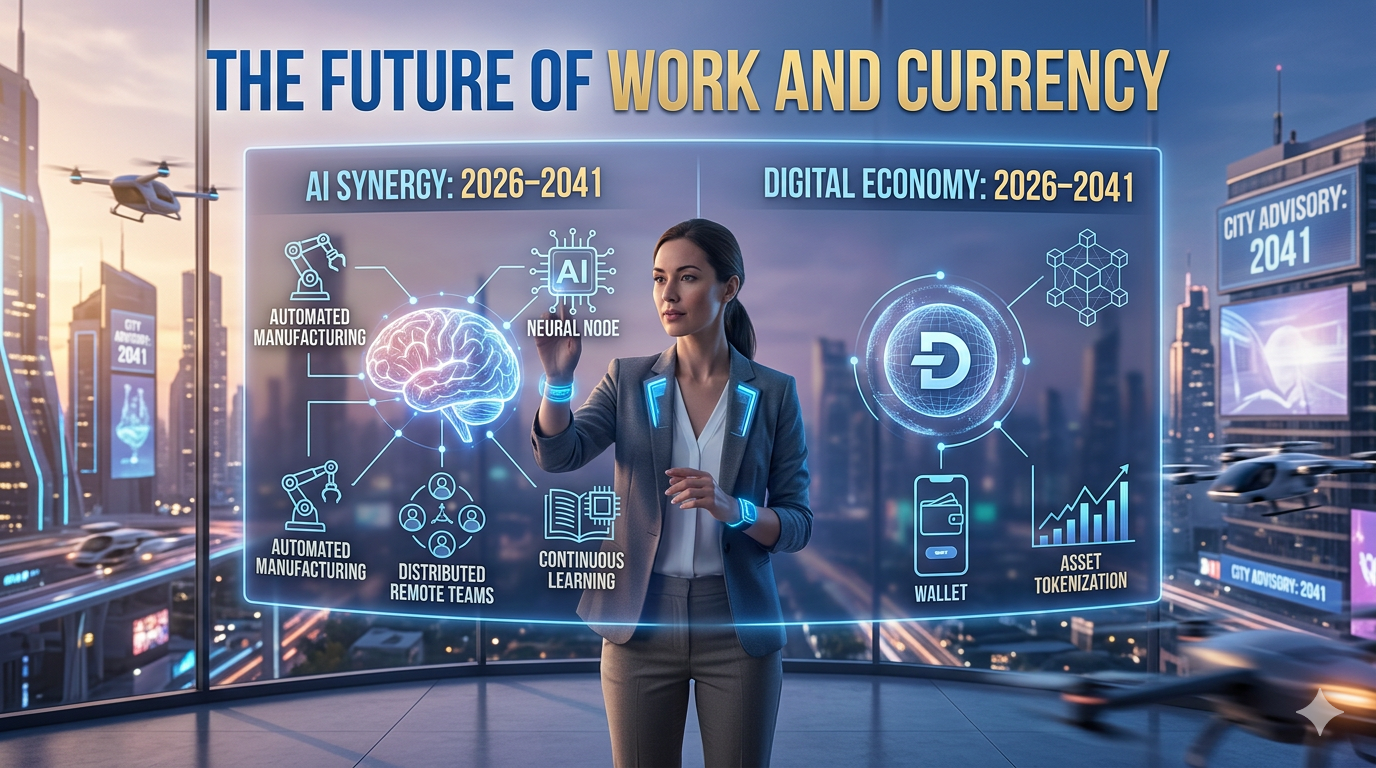
Executive Summary
The global job market is entering a period of unprecedented transformation driven by the rapid advancement of Artificial Intelligence (AI) and robotics. While there is a consensus that the nature of work will change fundamentally over the next 10 to 15 years, the scale and speed of this shift remain subjects of intense debate. This report explores the vision of Elon Musk, who predicts a post-scarcity “Universal High Income” society, and compares it with broader economic forecasts from institutions like the IMF, OECD, and major financial analysts.
Elon Musk’s Vision: The End of Labor and the Rise of Energy Currency
Elon Musk has consistently argued that AI and robotics will eventually surpass human capabilities in nearly all domains, leading to a world where human labor is no longer a requirement for survival. His predictions focus on several key pillars:
“In a future where anyone can have anything, you no longer need money as a database for labor allocation. If AI and robotics are big enough to satisfy all human needs, then the relevance of money declines rapidly.” — Elon Musk [1]
1. The “Optional” Nature of Work
Musk predicts that within 10 to 20 years (2035–2045), work will become a choice rather than a necessity. He likens future employment to a hobby—something people engage in for personal fulfillment, similar to gardening or painting, rather than for financial survival.
2. Universal High Income (UHI)
Unlike the concept of Universal Basic Income (UBI), which provides a minimum safety net, Musk envisions Universal High Income. In this scenario, the cost of goods and services drops so dramatically due to AI-driven productivity that everyone can enjoy a high standard of living without traditional employment.
3. Energy and Mass as the New Currency
As traditional money—which Musk defines as a tool for allocating human labor—loses its utility, he proposes that energy and mass will become the true measures of value. He envisions a “self-sustaining energy loop” where robots manufacture the very solar panels and batteries needed to power themselves and the broader economy, effectively decoupling society from the current monetary system [1, 2].
Expert Economic Consensus: Transformation vs. Total Replacement
While economists agree that AI will be highly disruptive, most institutional forecasts are more conservative than Musk’s “post-work” utopia. Current research suggests a period of intense job shifting rather than total job loss.
|
Feature |
Elon Musk’s Vision |
Institutional Consensus (IMF, OECD, Wharton) |
|
Primary Outcome |
Work becomes “optional” and hobby-like. |
Work is “transformed”; new roles emerge in AI oversight. |
|
Income Model |
Universal High Income (UHI). |
Targeted UBI or standard social safety nets. |
|
Currency |
Energy/Mass replaces money. |
Traditional currency persists; AI boosts global GDP. |
|
Timeline |
10–20 years for total transition. |
Incremental shifts over 20–50 years. |
Productivity and GDP Impacts
The Wharton School estimates that AI will increase global GDP by approximately 1.5% by 2035 [3]. Goldman Sachs suggests a potential 7% boost to global GDP over a longer period, though they warn of near-term unemployment fluctuations as businesses automate specific tasks [4].
Job Exposure and Displacement
The IMF reports that nearly 40% of global jobs are currently exposed to AI-driven change [5]. While some analysts predict that 50–60% of current roles will be automated by 2040, historical precedents suggest that new, unforeseen industries will emerge to absorb displaced workers, provided that education and policy adapt quickly enough.
Key Risks and Existential Challenges
Regardless of whether Musk’s or the economists’ vision prevails, several critical risks are universally recognized:
- The Meaning Crisis: Musk has raised the existential question of human purpose in a world where machines perform all tasks better than people. This “crisis of meaning” could become a central societal issue by the 2040s.
- Wealth Inequality: There is a significant risk that the benefits of AI-driven abundance will concentrate among those who own the capital (the robots and AI models), potentially widening the gap between developed and emerging nations [5, 6].
- Infrastructure Disparities: The IMF warns that countries with mature digital infrastructure will pull ahead, while developing nations may struggle to implement the systems necessary to benefit from the AI era.
Conclusion
The next 10 to 15 years will likely see a hybrid reality. While we may not reach a fully “work-optional” society by 2041, the automation of routine and cognitive tasks will be nearly total. Elon Musk’s vision of energy-based currency and post-scarcity abundance serves as a provocative “north star” for the potential of technology, even if the transition takes longer and remains more grounded in traditional economic structures than he predicts.
References
- Energy Digital: Elon Musk: Is Energy the New Currency of the AI Era?
- Fortune: Elon Musk: AI, robotics will make work optional and money irrelevant
- Wharton (UPenn): Projected Impact of Generative AI on Future Productivity Growth
- Yahoo Finance: Goldman Sachs warns AI-fueled layoffs could raise unemployment
- IMF: New Skills and AI Are Reshaping the Future of Work
- Anthropic (Dario Amodei): Machines of Loving Grace